
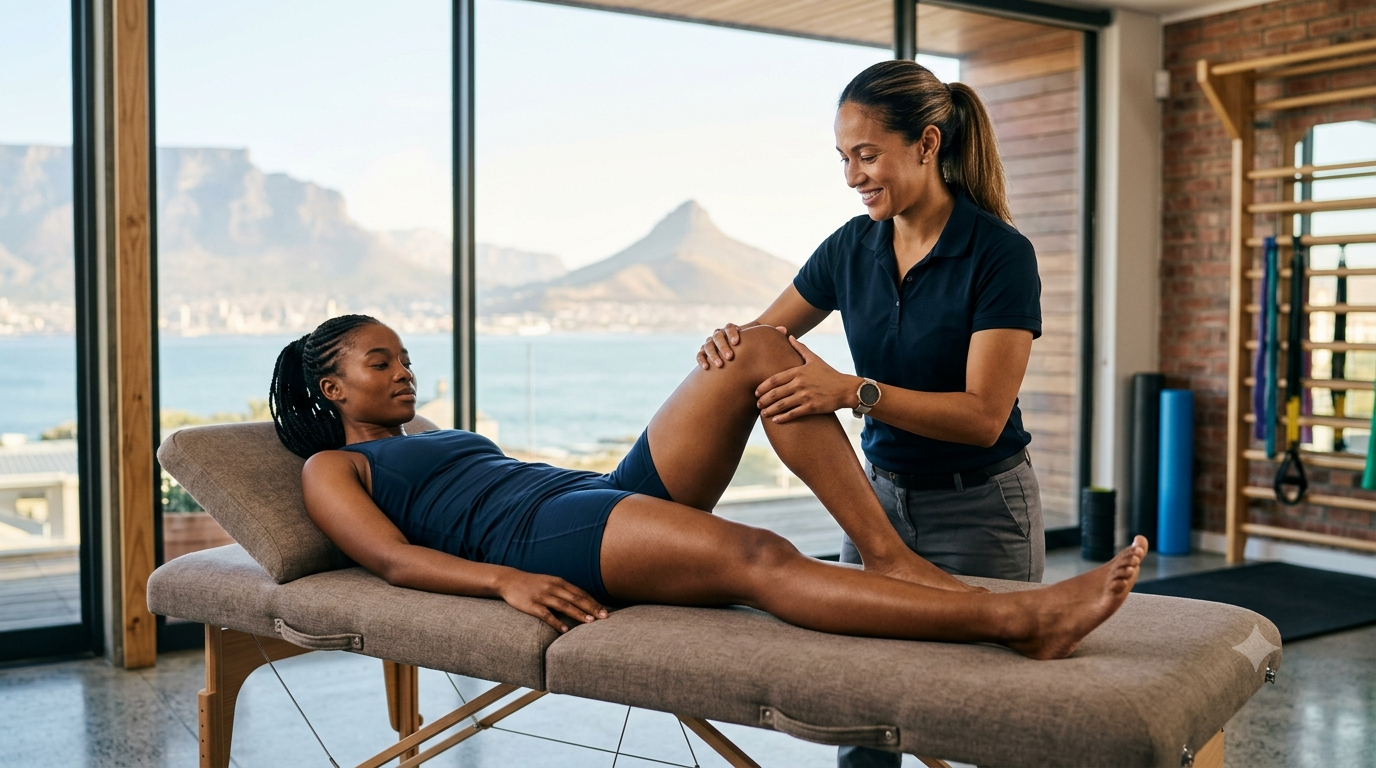
Knee Pain That Keeps Coming Back? You're Probably Treating the Wrong Spot
If your knees ache on the stairs, flare up after a run, or cave inward when you squat, the natural instinct is to focus on the knee itself: ice it, brace it, rest it. But knees are often the joint that pays the price for problems elsewhere. In my work as a biokineticist and rehabilitation specialist in Cape Town, most of the recurring knee pain I see is driven by what is happening above and below the joint. Fix those, and the knee usually settles.

The knee is caught in the middle
Your knee is a relatively simple hinge stuck between two very mobile areas, the hip and the ankle. When the hip is weak or the ankle is stiff, the knee is forced to absorb movement it was never designed to handle, twisting and collapsing inward under load. Over time that repeated stress becomes pain. So when someone tells me their knee started hurting for no reason, the reason is usually a little higher or lower down the chain.
Three common culprits
Weak glutes are a big one. When the muscles around the hip cannot control the thigh, the knee drifts inward on every step and squat. Stiff ankles are another: if the ankle cannot bend properly, the knee compensates by rolling in. And a sudden spike in training load, more distance, more weight or more sessions than your body is used to, overwhelms tissue that has not been prepared for it. Often it is a mix of all three.
Why rest alone rarely fixes it
Rest calms an angry knee, which is why the pain fades when you stop. But rest does not build the strength or control that was missing in the first place, so the moment you return to normal activity the same forces are back and so is the pain. Lasting relief comes from rehab that rebuilds the hip and ankle's ability to control the knee, then gradually reloads the joint so it can handle real life again.
What good knee rehab looks like
A proper programme starts with an assessment to find your specific driver, then targets it: glute and hip strengthening, ankle mobility, single-leg control, and a sensible progression back to running or lifting. This is the structure behind our focused knee rehabilitation approach, a reset to calm the pain and rebuild the foundations, followed by longer-term strength so it does not return.
When to get it looked at
Sharp or locking pain, giving way, or significant swelling deserve a professional assessment sooner rather than later. So does knee pain that has been grumbling for more than a couple of weeks. The earlier we identify the driver, the quicker and more completely it resolves.
Frequently asked questions
Why does my knee pain keep coming back?
Recurring knee pain is usually driven by weakness or stiffness at the hip and ankle rather than the knee itself. Until those are addressed, the knee keeps absorbing forces it cannot control, so the pain returns whenever you resume activity.
Should I rest or exercise for knee pain?
Short-term rest can calm a flare-up, but rest alone rarely fixes the cause. Guided strengthening and mobility work for the hip, ankle and knee is what produces lasting relief.
Can a biokineticist help with knee pain?
Yes. A biokineticist assesses the whole movement chain, identifies what is driving your knee pain, and prescribes a progressive exercise programme to rebuild control and reload the joint safely.
Book with Luyolo Cengimbo
If your knee pain keeps returning, book a knee assessment with Luyolo at Peak Movement in Cape Town and find out what is really driving it, then follow a plan built to keep it gone.


Comments